Deadline Changes Perception of Time
Senior year, we go to school and take it all in…trying to capture the memories and take nothing for granted, I mean it’s the last year of high school right? But what if it were your last year alive? What if your classmate, the one you just called out for asking a “stupid” question, was burying a secret so heavy, that his therapist couldn’t even help him? That if the student next to you knew he was going to die in less than a year and decided to tell no one. Not even his parents.
In Chris Crutcher’s Deadline, senior Ben Wolf discovers that he has a terminal illness at his routine sports physical. Ben decides against telling anyone, including his parents, in an effort to live his last year as a “normal” teenager. Since Ben is 18, the doctor must comply. The book from that point leads the reader’s mind on a quest of questions. ‘What would I do if I were in Ben’s position?’ ‘What if someone I know was going through the same thing?’
Ben decides that in his last year, he is going to do something that matters.
He spends more time with people he that would have usually looked by. He asks out the girl he was terrified to speak to. He searches for the story in people instead of imposing judgement. And he questions everything shamelessly in an effort to understand.
Crutcher subtly guides the reader to take a look at his or her own life. Readers challenge themselves with thoughts such as ‘What am I doing that really matters in the big picture?’ ‘What changes would I make if I knew it was my last year?’
While not a complex literary novel, Crutcher’s Deadline broadcasts his message to readers in a compelling and relatable way that pushes the reader to understand that there truly is more to life than just living.
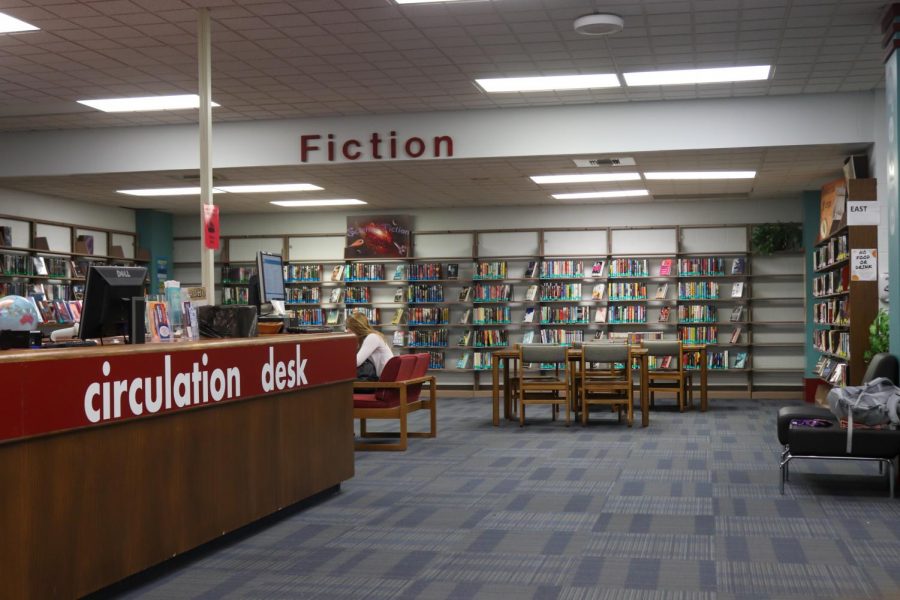
Deadline can be found in Rider’s library. To access the book trailer, visit this link: http://www.teachertube.com/viewVideo.php?video_id=204232&title=DEADLINE__by_Chris_Crutcher
eBooks catching up to bound books in race to top
It’s everywhere. It’s on an airplane. It’s in a camping tent. It’s at home and hotel. It’s at school. The sleek device that whispers stories of fiction and non-fiction through its glossy screen. With the single motion of a finger, a page has been turned. No more losing your place, no more licking fingers to get a grip on that stubborn page. It’s the Kindle.
Technology is rapidly advancing. From phones, computers, and TVs to news broadcasting, radio, and now books. The world is swarming around this revolution.
Some people welcome this change while others cling to the spine bound books.
“A lot of die-hard’s just want that book in their hands,” librarian Sally George Mroczkowski said. “They love books, they want to feel books.”
With screens replacing paper and books, it is possible that many revolutionary and historically important things like libraries, the printing press and journals will soon become obsolete. However, the Kindle does have advantages.
“[With a Kindle, you] have access to countless, thousands of books at a time. If you were going on a trip and you wanted to take more than one book it would become cumbersome,” said Mroczkowski. “So one advantage of it is the ease of carrying.”
And with its advantages come also its disadvantages. One disadvantage is expense. The fact that one must first buy the Kindle of their preference, and then pay for each book is a turn-off for some people.
“I’ve downloaded a few books, but to get the books I want I can just go to the library and check those out,” Mroczkowski said.
The cost of electronic readers is also a limiting factor of improving the education system.
“The expense involved in kids having Kindles is just one of the huge obstacles, [but] once everything converts, textbooks [will] convert. It just it can’t be financed right now,” said Mroczkowski.
While Kindles are a popular choice, it is just one of many electronic books out on the market.
“There’s Kindle versus Nook [and] different eBooks, but there is no universal format yet,” said Mroczkowski.
Other electronic books include the iPad and Playaway digital audio books.
Whatever the preference of the reader–paper books or various electronic books–there is a common theme that still unites readers all over the world.
“The main use of a book is just to share thoughts and ideas and feelings,” Mroczkowski said. “And whether you read that on a Kindle or whether you read that in a book, literacy is for all.”
Lost Textbooks Create Budget Strain
January 8, 2010 by Branden Robinson
Filed under News
Last year, lost textbooks accounted for $10,000 of school debt, and the school is still not finished paying for the problem.
“We lost a lot of books last year,” assistant principal Peter Braveboy said. “Before, many seniors failed to turn in their books.”
Now, the school has a new policy. The school will not provide students with their transcripts if they have book fines, and many teachers have regular book checks.
“Book checks reduce the number of lost books, and with the budget strain, we cannot afford to take the money away from the general fund to pay for these lost books,” Braveboy said. “If you think you lost your book, you can pay for it, and if you find the book within 60 days, you can get all your money back. We can do payment plans if the student needs to; they will just have to pay monthly, instead of in one lump sum.”
This new plan, Braveboy said, should greatly lower the “number of lost books.”
“I advise all student who have a one semester class to turn in their books after the first semester,” Braveboy said. “We don’t want to make students pay for these books, but we have to.”
Picoult’s Plain Truth Worth Reading
January 8, 2010 by JordanCampagna
Filed under A&E, Uncategorized
Famous for writing My Sister’s Keeper, Jodi Picoult has a whole array of other, fabulous books out there, each one usually covering a different controversial topic.
In Plain Truth, an Amish girl gets pregnant and has a child. She’s unmarried though. In her world, that is one of the worst things you can do, so when the newborn is found dead hours after birth, they blame the girl, Katie Fisher, who claims she wasn’t even pregnant. To stay at her farm and not in jail, she must be under 24-hour watch. When none of her family offers, her attorney, Ellie Hathaway somehow finds herself living on an Amish farm for months, with a family that believes everything that she doesn’t. She must work to gain their trust to discover the truth about Katie. Through it all, she not only solves the case, she also discovers who she is.
The book lets you inside an Amish family’s life. It’s a common thought that they are weird, secluded people, but the book shows you how they live. They don’t shun outsiders, they embrace them.
Jodi Picoult has the ability to make you feel like you are there, she can paint such good of a picture that you feel like you are there with Katie while she milks the cows. You feel for Samuel when he hears his girlfriend got pregnant. You feel torn like her mother when she must choose between supporting her daughter or staying with her husband.
The book makes you laugh, it makes you cry, and it makes you want more.